What is Cabruca?
Cabruca is a traditional agroforestry system from the southern region of Bahia, Brazil. It consists of cultivating cocoa (Theobroma cacao) under the shade of native trees from the Atlantic Forest. Instead of clearing the entire area, the producer performs a thinning (cutting only the understory and some smaller trees), preserving tall trees to provide shade for the cocoa.
The name comes from the verb “cabrucar”, which means precisely this process of clearing the brush without felling the large trees.
Origin
It emerged in the 18th century (around 1746), in the captaincy of Ilhéus, when colonizers realized that cocoa developed well under the shade of the forest, imitating its natural habitat in the Amazon.
Main Characteristics
| Aspect | Description |
|---|---|
| Type | Agroforestry system (SAF) |
| Main crop | Cocoa |
| Structure | Native canopy trees + cocoa trees in the understory |
| Native tree density | Minimum of 20 to 40 trees per hectare (varies according to legislation) |
| Region | Southern Bahia (Ilhéus, Itabuna, Una, etc.) |
| Biome | Atlantic Forest |
Environmental Importance
Cabruca is considered one of the most harmonious ways to reconcile agricultural production and environmental conservation. Among its benefits:
- Biodiversity conservation: it shelters species of fauna and flora from the Atlantic Forest, including trees threatened with extinction.
- Forest connectivity: it functions as an ecological corridor between forest fragments.
- Carbon sequestration: estimated at around 170 tons of carbon per hectare.
- Soil and water protection: it reduces erosion and maintains springs.
- Microclimate: it keeps temperature and humidity more stable.
Research has already recorded more than 40 tree species in just 2.6 hectares of cabruca, with a Shannon diversity index of 3.35 — a fairly high value.
Economic Importance
Cabruca cocoa has potential for valorization in the premium market, due to its sustainable character and differentiated quality. Bahia was once the world’s largest cocoa producer, and Cabruca is a central part of that history.
Current Challenges
Despite its benefits, cabruca faces serious problems:
- Low productivity: the average is only 200 kg/ha, when it could reach 1,000 kg/ha with proper management.
- Lack of technical assistance: many producers do not know how to correctly manage shade trees and cocoa trees.
- Pressure for conversion: some producers replace cabruca with full-sun cultivation or clear land to sell timber.
- Absence of payment for environmental services: the producer receives nothing for the conservation they maintain.
- Traceability requirements: regulations such as the European zero-deforestation regulation (EUDR) pressure small producers without organization.
Public Policies and Recent Initiatives
- Draft laws (such as PL 4995/2009 and PL 4107/2025) seek to create a National Cabruca Policy, with credit, technical assistance, and payment for environmental services.
- In 2026, FAO and CEPLAC launched a cooperation project to:
- Restore 12,000 hectares of cabruca;
- Improve the management of more than 203,000 hectares;
- Triple average productivity;
- Increase the income of beneficiary families by 30%.
- The most recent proposal provides for a minimum payment of 1 arroba of cocoa (15 kg) per hectare/year as environmental compensation.
Summary
Cabruca is a unique system in the world: it produces cocoa and conserves forest at the same time. It is historical heritage, environmental patrimony, and a source of income for thousands of families in southern Bahia. Its future depends on technology, market valorization, and public policies that recognize its environmental value.
Would you like me to go deeper into any specific aspect — for example, management, legislation, comparison with other agroforestry systems, or the premium cocoa market?
FAO Project for the Conservation of the Atlantic Forest through Sustainable Management of Cocoa Agroforestry Landscapes.
 Main Project Information
| Item | Content |
|---|---|
| Project Name | Conservation of the Atlantic Forest through sustainable management of cocoa agroforestry landscapes |
| Launch Date | April 8, 2026 |
| Launch Location | Ilhéus, Bahia, Brazil |
| Executors | Ministry of Agriculture and Livestock of Brazil (MAPA), Executive Commission of the Cocoa Farming Plan (CEPLAC) |
| Technical Support | Food and Agriculture Organization of the United Nations (FAO) |
| Funding Source | Global Environment Facility (GEF) |
| Operational Partner | Sitawi Finanças do Bem |
 Central Objectives
The project’s central strategy is to strengthen the cabruca planting system, aiming to curb the degradation of the Atlantic Forest and the loss of biodiversity. Cabruca is the traditional method of growing cocoa under the shade of native trees, which provides biological corridors, water regulation, and improves ecological resilience.
 Main Targets
Environmental Targets:
- Restore 12,000 hectares of cocoa in the cabruca system
- Improve the management of more than 203,000 hectares of protected areas (including APA Pratigi and APA Baía de Camamu)
- Reduce 3.72 million tons of greenhouse gases
Economic Targets:
- Triple the average productivity of cabruca cocoa (from the current roughly 176 kg/ha to 480 kg/ha)
- Increase the income of beneficiary families by 30%
- Increase the sale price by 10% through access to premium markets
Social Targets:
- Benefit 3,000 producers organized in the CIAPRA, CIMA, and CDS-LS consortia
- Ensure that at least 50% of beneficiaries are women and young people
 Innovation and Infrastructure
The project includes multiple innovative initiatives:
- Blockchain Traceability: complete tracking of cocoa from farm to chocolate bar
- Cocoa School: a permanent training structure for agricultural technicians and producers
- Territorial Intelligence Center (CIT): real-time monitoring of landscape and biodiversity
- Sustainable Rural Credit (CRA Model): facilitating producers’ access to financing
 Institutional Partners
The project collaborates with various local institutions, including:
- Biofábrica da Bahia (seedling production)
- Associação Cacau Sul da Bahia (geographical indication brand)
- Rede Agroecológica Povos da Mata (participatory organic certification)
- Observatório Social do Parque Científico e Tecnológico do Sul da Bahia (PCTsul)
This initiative positions cabruca as an international model of “productive conservation,” demonstrating that sustainable agriculture can coexist with the conservation of native and endemic species.
GIAHS is a certification program led by FAO that identifies and protects traditional agricultural systems of globally significant value, with 104 sites already designated worldwide. The FAO project in southern Bahia, Brazil, is essentially a “technical and financial support project” that leverages the traditional shade-grown cocoa cultivation system “Cabruca” to achieve Atlantic Forest conservation objectives and improve producers’ income, with financing from the Global Environment Facility (GEF).
What is GIAHS?
The full name of GIAHS is “Globally Important Agricultural Heritage Systems”, a program of the Food and Agriculture Organization of the United Nations (FAO) launched at the 2002 World Summit on Sustainable Development and formally incorporated as an FAO institutional project in 2015.
Its nature is: it is not about protecting “relics,” but about dynamically identifying and supporting those land-use systems formed over generations that possess rich agricultural biodiversity, traditional knowledge, and unique landscapes, and that still maintain production and livelihood capacities. These systems demonstrate how humans can coexist harmoniously with nature while ensuring food security.
Current scale: as of 2025, FAO has designated 104 GIAHS sites globally, distributed across 29 countries.
Designation and management process: countries or interested parties submit proposals, which are evaluated by an independent Scientific Advisory Group (SAG). The proposal must demonstrate the system’s unique value in terms of food and livelihood security, agricultural biodiversity, traditional knowledge, culture, and landscapes. After designation, a “dynamic conservation plan” must be implemented to ensure the system continues to develop.
 How does the FAO project in southern Bahia work in practice?
This project was launched in April 2026, with an expected duration until 2032. Its central logic is: use “Cabruca” to protect the forest and, through the forest, generate income.
Operational mechanism: FAO provides technical support, GEF (Global Environment Facility) provides financing, the Brazilian government agency CEPLAC is responsible for execution, and the local social institution Sitawi is the operational partner. The project directly serves 3,000 cocoa producers, organized through three associations (CIAPRA, CIMA, CDS-LS), with the requirement that at least half of the beneficiaries be women and young people.
How producers participate specifically:
-
Continuous technical assistance: technicians teach producers how to properly manage shade trees and cocoa trees to increase productivity. The goal is to raise the average yield from about 200 kg/hectare to 1,000 kg/hectare or more, that is, triple it.
-
Green financing: through the Sustainable CRA model (Certificate of Agribusiness Receivables, a sustainable agricultural financing instrument), producers obtain working capital, using their environmental and social practices as collateral.
-
Access to premium markets: the project establishes a connection with the fine cocoa market, where Cabruca cocoa, due to its quality and environmental history, can obtain preferential prices.
Three key tools:
- Blockchain Traceability: record the entire process of cocoa from the field to the chocolate bar, meeting the demands of European buyers regarding origin and deforestation.
- Cocoa School: a permanent training center that trains producers and technicians.
- Territorial Intelligence Center (CIT): use remote sensing technology and real-time monitoring to track changes in landscape and biodiversity.
Main result targets:
- Environmental: restore 12,000 hectares of Cabruca cocoa; improve the management of more than 203,000 hectares of protected areas; reduce 3.72 million tons of greenhouse gases.
- Economic: increase producers’ income by 30%; triple productivity.
- Social: serve 3,000 producer families, with at least half being women and young people.
 The difference between the two
It is important to distinguish: GIAHS is a “seal” of recognition and a broad conceptual program; while the project in southern Bahia is a specific action that applies the idea of “productive conservation” on the ground. If Cabruca in the future becomes a GIAHS site, the region will gain greater visibility and financing opportunities; but even if it has not yet obtained the designation, this project is already operating with its own financing and targets.
What Green Goods is, in practice
Green Goods is a “local-first” regenerative compliance and impact reporting platform, built by the Greenpill Dev Guild. It works as a PWA (Progressive Web App) designed to function under field conditions: offline-first, on mid-range Android devices, with support in English, Portuguese, and Spanish.
The central workflow is the MDR (Media → Details → Review):
- Media: the field worker takes photos or videos of the work performed.
- Details: fills out a form specific to the action (e.g., number of trees planted, species, geographic location).
- Review: reviews and submits. The work enters a community review queue.
The verified work is then transformed into on-chain attestations (EAS) and aggregated into Hypercerts (tokenized impact certificates). This allows the impact to be tracked and, theoretically, funded by donors or funds.
Direct connection with the Brazilian context
Green Goods already has an active presence in Brazil and is targeting exactly the kind of work relevant to GIAHS.
- Pilot in Brazil: In August 2024, a pilot event was held in Rio Claro, SP, where participants used the app to document the removal of an invasive species (Leucaena leucocephala) and the planting of native trees.
- Agroforestry Domain: The platform already has a specific action domain for Agroforestry, with impact metrics such as “trees planted, species diversity, canopy cover, harvest yield.” This is directly applicable to Cabruca.
- Language and context: Full Portuguese support and the design for low connectivity show that it was designed for realities like that of Bahia.
 How Green Goods aligns with GIAHS principles
For a tool to be useful in a GIAHS site, it needs to support “dynamic conservation” — that is, keeping the system alive and productive, not freezing it. See how Green Goods fits:
| GIAHS Principle | How Green Goods can help |
|---|---|
| Monitoring of agricultural biodiversity | The tool allows recording observations of flora and fauna, species counts, and canopy cover, creating a continuous and verifiable database. |
| Economic valorization of products and services | By transforming conservation work into Hypercerts, Green Goods creates a digital “backing” that can be used to access premium markets or payments for environmental services. |
| Empowerment of local communities | Verification is done by “neighbors verifying neighbors,” through local stewards, and not by a distant authority. This aligns with the community governance that GIAHS values. |
| Traditional knowledge | The app allows the producer’s knowledge about their land (e.g., “this tree is good for shade”) to be recorded as part of the impact data, giving visibility to local knowledge. |
 Limitations and what Green Goods does not do
It is crucial to understand what the tool is not.
- It is not a FAO seal. GIAHS recognition is a formal application and evaluation process conducted by FAO. Green Goods is a monitoring and evidence tool that could feed this process, but it does not grant the title.
- It does not replace formal governance. GIAHS requires governance structures, conservation plans, and complex institutional agreements. Green Goods is a coordination and recording layer within this ecosystem, not the entire structure.
- Focus on evidence, not technical assistance. The app records what was done. It does not teach the producer how to manage cabruca nor does it provide credit directly. It creates the verifiable record that can be used to access credit or assistance.
 Conclusion
Green Goods is a promising tool for the GIAHS ecosystem, especially for the Cabruca context in Bahia. It solves a practical problem: how to document and verify, cheaply and under field conditions, the work of productive conservation that GIAHS promotes.
It fits as a community monitoring and traceability layer within a GIAHS initiative. If Cabruca is ever recognized as a GIAHS site, tools like Green Goods would be exactly the kind of infrastructure needed to demonstrate that the system is being maintained “dynamically” and to connect producers to new financing flows.
The technical basis is solid: Green Goods’ entry point is exactly planting traceability
The core function of Green Goods is the “MDR workflow (Media→Details→Review)”: field workers take photos, fill out forms, and the reviewed information is encapsulated on the Ethereum blockchain as immutable “attestations.” In the “Agroforestry” domain, the metrics it supports directly include: number of trees planted, species diversity, canopy cover, harvest yield.
Applying this to the scenario you mentioned: when registering cocoa seedlings at the time of planting, it is possible to record in a structured way the variety of the seedlings, place of origin, quantity, planting plots, and survival status. This is precisely the kind of baseline evidence material that a GIAHS application needs to provide.
 The Biofábrica side: there is already a physical basis for traceability
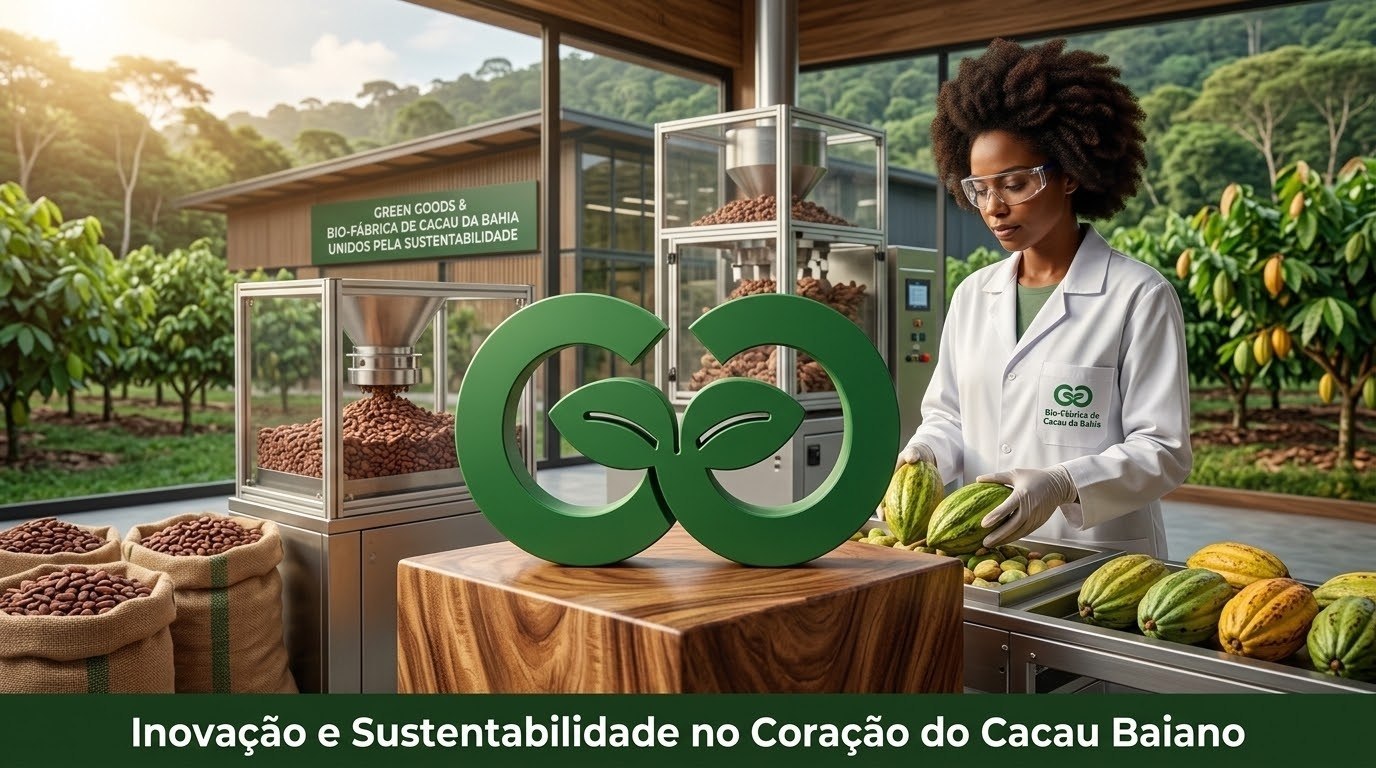
The Cocoa Biofábrica of Bahia is currently the largest cocoa seedling multiplication center in the world, with 20 nurseries, and an annual production capacity of up to 12 million seedlings. Its seedling production system already has rigorous standards: selection of genetic material, substrate control, rooting techniques, acclimatization, and other key processes are clearly emphasized in training.
What does this mean? The source of seedlings is controllable and production standards are clear. Green Goods does not need to “create from scratch” the origin of the data; it connects directly to the batch output information already existing at the Biofábrica, becoming a lightweight traceability layer “nursery → planting.”
 Alignment with the core requirements of GIAHS
The GIAHS application requires demonstrating five main items, and planting traceability is directly applicable to at least three of them:
| GIAHS evaluation criterion | Support from the traceability solution |
|---|---|
| Food and livelihood security | Traceability of seedling origin helps ensure the quality and productivity of cocoa, which is concrete support for farmers’ livelihood security |
| Agrobiodiversity | It is possible to record which species were planted, where they were planted, generating spatially explicit biodiversity distribution data |
| Traditional knowledge and technology systems | Recording the Cabruca planting context (under which native trees, with what spacing) can be structured, helping demonstrate the continuity of “Cabruca technology” |
Especially regarding the third point, GIAHS documents emphasize the need to explain “natural resource management systems that support agricultural activities.” When Cabruca plantings are digitized and traced, the traditional logic of “planting cocoa under shade trees” becomes verifiable and auditable operation records, which is far more persuasive than a textual description alone.
Limitations worth noting
Green Goods traceability solves the problem of “proof of origin,” but GIAHS requirements go further. GIAHS also examines:
- Traditional knowledge system: how shade trees are selected, what the planting rules are, how this is transmitted between generations. Currently, Green Goods is more focused on outcome entry, not knowledge documentation.
- Culture and social organization: festivals, community cooperation systems, values. This is a dimension that Green Goods cannot currently cover.
- Landscape characteristics: the beauty and uniqueness of the Cabruca landscape require field assessment and remote sensing analysis, not just planting point records.
Conclusion
Using Green Goods to trace the chain “Biofábrica → nursery → Cabruca planting” is a technically feasible starting point and highly relevant to GIAHS criteria. It transforms planting records that previously existed only on paper or Excel into immutable and spatially anchored evidence on the blockchain, which has direct practical value both for GIAHS review and for the subsequent sale of premium cocoa with “origin traceability.”
If this data chain is truly established, it could become one of the most solid “production-level evidence layers” of the GIAHS application for Cabruca.